One actuator. Contact-triggered adaptation.
A passive differential compensates for target offset, while HSA fingers transition from pinching to enclosure after contact.
I’m Xiaoqian Zhang, a joint PhD researcher at the University of Genoa and the Technical University of Munich. I develop soft grippers and compliant wrist mechanisms that turn simple actuation into useful, adaptive motion.

Explore four mechanisms through design animations, prototype demonstrations, and the papers behind them.
A passive differential compensates for target offset, while HSA fingers transition from pinching to enclosure after contact.
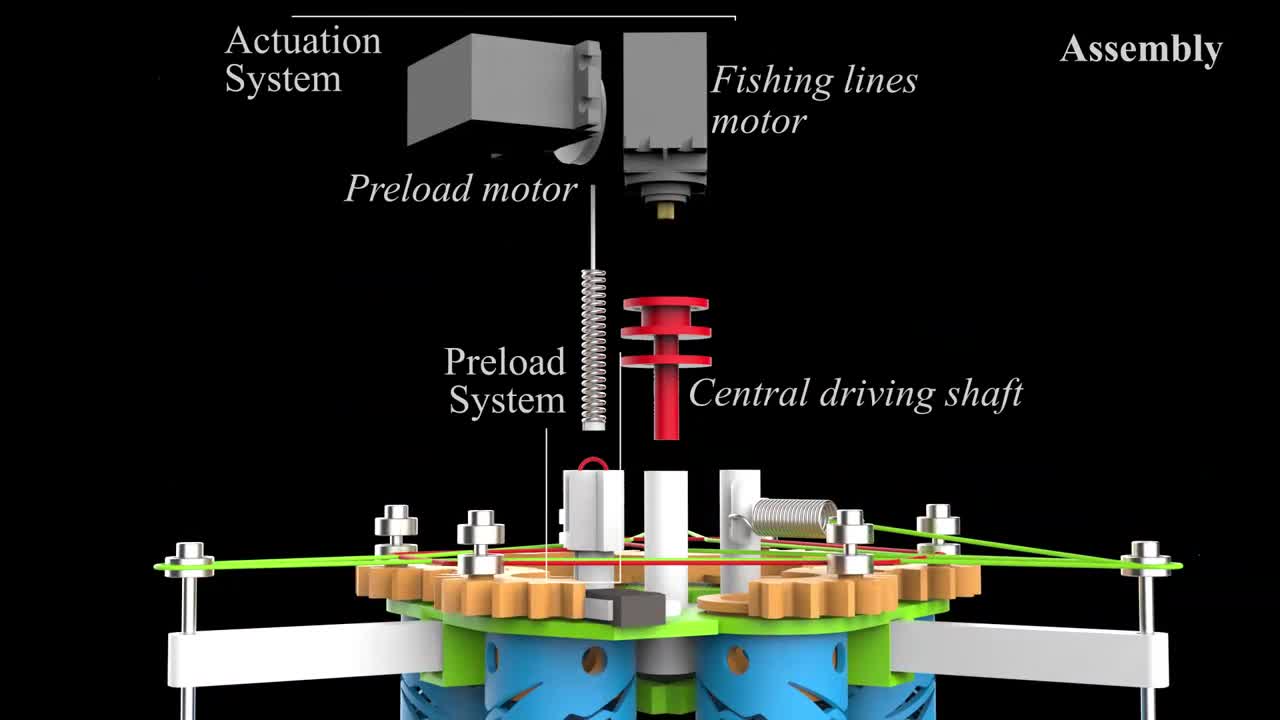
A three-finger soft gripper separates size adaptation from finger closure and uses HSA-inspired pre-shaping to improve contact.
A compact dual-cylinder architecture combines active flexion/extension and pronation/supination with passive compliance.
TriHSA uses three HSA cylinders to generate flexion/extension, radial/ulnar deviation, and pronation/supination.
My research combines mechanism design, handed shearing auxetics (HSA), underactuation, passive differentials, finite-element analysis, fabrication, and experimental validation.
I work on two connected directions: adaptive end-effectors for delicate object handling, and multi-DoF compliant wrist modules for prosthetic applications. Before my PhD, I worked on rehabilitation-device development at the Shenzhen Institutes of Advanced Technology, Chinese Academy of Sciences.
Joint supervision: Prof. Giovanni Berselli, University of Genoa, and Prof. Cristina Piazza, TUM/MIRMI.
I welcome technical discussion about adaptive grasping, HSA structures, compliant wrists, and experimental methods.